
Introduction
One of the most common questions I get after 10+ years in digital marketing is: “How long will it take for my website to rank on Google?”
The honest answer? It depends.
In 2026, SEO is more competitive, smarter, and more user-focused than ever. Ranking on Google is no longer about quick tricks—it’s about consistency, strategy, and trust. In this blog, I’ll break down realistic timelines and what actually affects your rankings.
The Short Answer
On average, it can take:
- 3 to 6 months for initial results
- 6 to 12 months for noticeable rankings
- 12+ months for strong, stable rankings
However, this timeline can vary depending on multiple factors.
Why SEO Takes Time
1. Google Needs to Trust Your Website
Google doesn’t rank new websites instantly. It takes time to:
- Crawl your website
- Understand your content
- Evaluate your credibility
Trust is built over time through consistent activity and quality signals.
2. Competition is Higher Than Ever
In 2026, almost every business is investing in SEO.
If you’re targeting competitive keywords like:
- “Digital marketing services”
- “Best clothing brand”
it can take longer because you’re competing with established websites.
3. Content Needs to Prove Value
Google now prioritizes helpful, high-quality content.
You can’t just publish one blog and expect results.
You need to consistently create content that:
- Solves problems
- Answers user queries
- Provides real value
Factors That Affect Ranking Time
1. Website Age and Authority
- New website → Takes more time
- Established website → Faster results
Older domains with authority have an advantage.
2. Competition Level
- Low competition keywords → Faster ranking
- High competition keywords → Slower ranking
Choosing the right keywords is crucial.
3. Quality of Content
Content that is:
- Well-written
- Informative
- Optimized properly
will rank faster than low-quality content.
4. SEO Strategy
A strong SEO strategy includes:
- Keyword research
- On-page optimization
- Technical SEO
- Link building
Without a proper plan, ranking can take much longer.
5. Backlinks (Authority Signals)
Backlinks from trusted websites act as votes of confidence.
More high-quality backlinks = faster and better rankings.
6. Website Performance
Google prioritizes websites that:
- Load fast
- Are mobile-friendly
- Provide a smooth user experience
A slow or poorly designed website can delay rankings.
Realistic SEO Timeline Breakdown
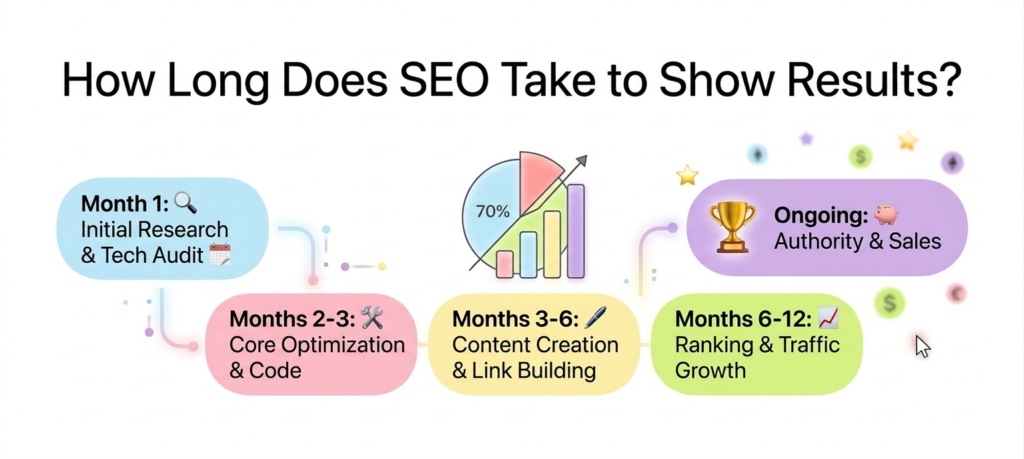
Month 1–2: Foundation Phase
- Website setup and optimization
- Keyword research
- Initial content creation
👉 Little to no traffic expected
Month 3–4: Early Growth
- Content starts getting indexed
- Some keywords may begin ranking
👉 Small increase in traffic
Month 5–6: Momentum Building
- Improved rankings
- More visibility
- Better engagement
👉 Noticeable traffic growth
Month 6–12: Scaling Phase
- Strong keyword rankings
- Increased authority
- Consistent traffic
👉 Leads and conversions improve
12+ Months: Authority Stage
- Stable rankings
- High traffic
- Strong brand presence
👉 Long-term growth and ROI
Can You Rank Faster?
Yes—but only with the right approach.
Tips to Speed Up SEO Results:
- Target low-competition keywords
- Publish high-quality content regularly
- Optimize technical SEO
- Build quality backlinks
- Focus on user experience
- Update old content
Avoid shortcuts like black-hat SEO—they may give temporary results but can harm your website in the long run.
Common Misconceptions
“SEO Gives Instant Results”
No, SEO is a long-term strategy, not a quick fix.
“One Blog is Enough”
SEO requires consistency. One blog won’t rank your website.
“More Keywords = Better Ranking”
Keyword stuffing can actually hurt your rankings.